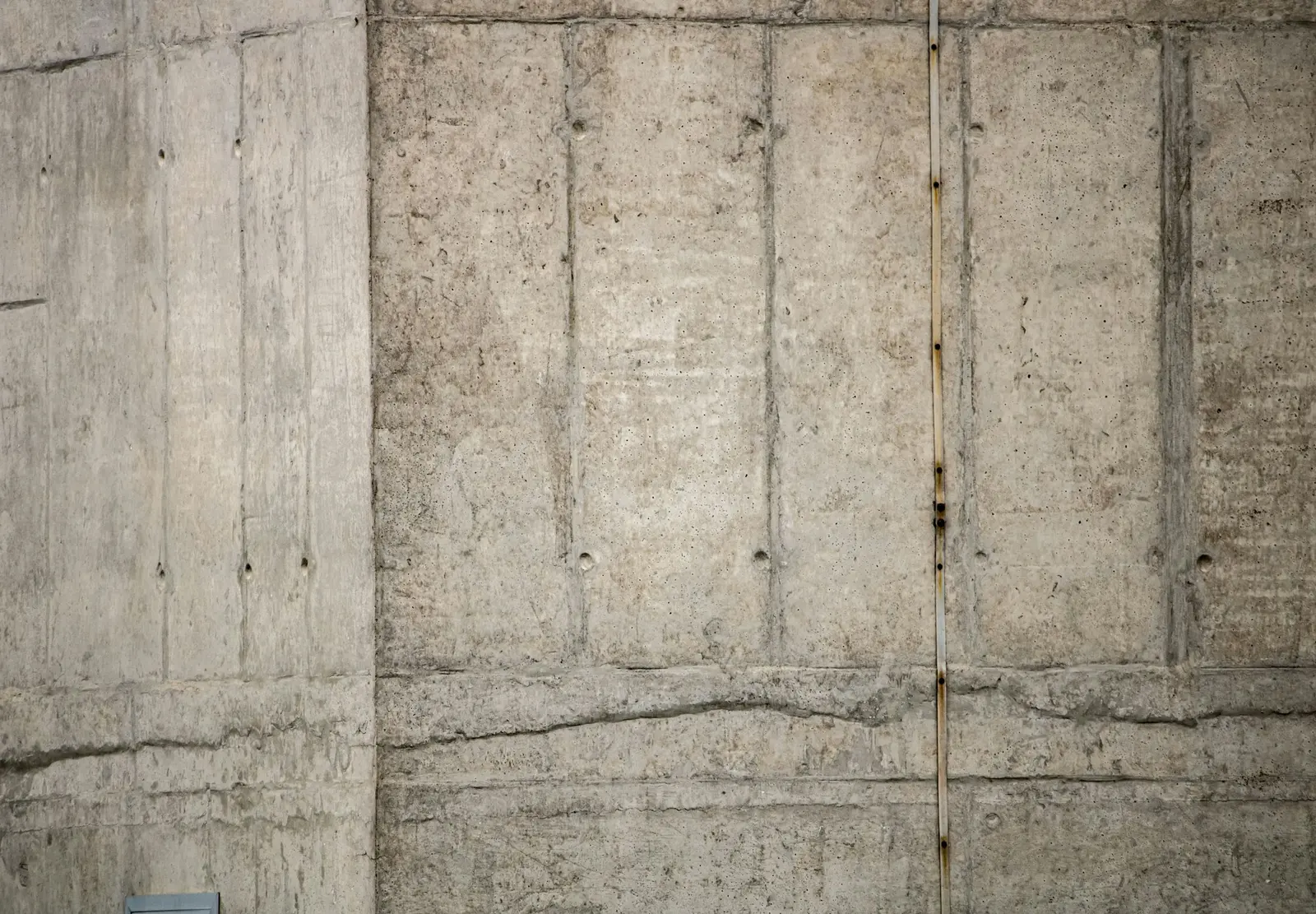
Foundation crack repair
Most leaks in a house built after 1970 come through one crack in a poured wall. Injected with polyurethane from the inside, the crack fills front to back and stays sealed as the wall moves with the seasons.
- Whereinside, at the crack
- Seasonany
- Time2–4 hours
- Disturbsnothing; a drop sheet
In section
Why we inject rather than patch
A patch on the inside face seals the last centimetre of a 20 cm crack. Water still enters the wall, sits in the crack, and finds the edge of the patch by the second spring. Injection fills the crack through the whole thickness of the concrete, so there is no water inside the wall at all.
- Ports every 20 to 30 cmSet along the crack and the face sealed between them with a fast-cure paste.
- Low-pressure injectionPolyurethane resin is pumped in from the bottom port up. It reacts with the moisture in the crack and expands to fill it.
- Ports removed, face ground flushThe paste and ports come off. What remains is a filled crack and a wall you can paint.
Which cracks
What we inject and what we send to an engineer
Vertical or diagonal, hairline to 6 mm
Shrinkage cracks from curing, or from the first winters of settlement. Injected and done.
At a window corner or a pipe
Stress concentrates at openings. Same repair, with the penetration itself sealed.
Tie holes and honeycombing
Not cracks, but they leak the same way. Sealed with the same materials in the same visit.
Horizontal, stepped, or a bowing wall
Those are signs of load, not shrinkage. We photograph and refer to a structural engineer before any sealing, because sealing a moving crack wastes your money.
One crack, one visit. Send a photo with the form and we can usually tell you the same day whether it is an injection job.
Book a free assessmentQuestions
About cracks
Is a crack in my poured concrete wall serious?
Most vertical and diagonal cracks in a poured wall are shrinkage cracks from when the concrete cured. They are not structural, but they are the most common leak path in a house built after about 1970. Injected with polyurethane they stay sealed. A horizontal crack, a crack that is wider at one end, or a wall that bows inward is a different matter and needs an engineer before anyone waterproofs it.
Our house has a concrete block foundation. Is that a problem?
Block walls are hollow, so water that gets past the outer face fills the cores and comes out at the bottom course, often along a whole wall rather than at one spot. Injection does not work on block. The repair is either exterior waterproofing of the wall face or an interior system with a membrane that drains the cores at the base. Older houses in the village cores of the township are mostly block; newer subdivisions are poured.
How long does the work take?
Crack injection: a few hours. An interior drainage system on one or two walls: two to four days, including the new concrete. An exterior excavation of one wall: three to five working days depending on depth, access and weather. We tell you the schedule in the written scope and we do not open a wall we cannot close before the next rain.