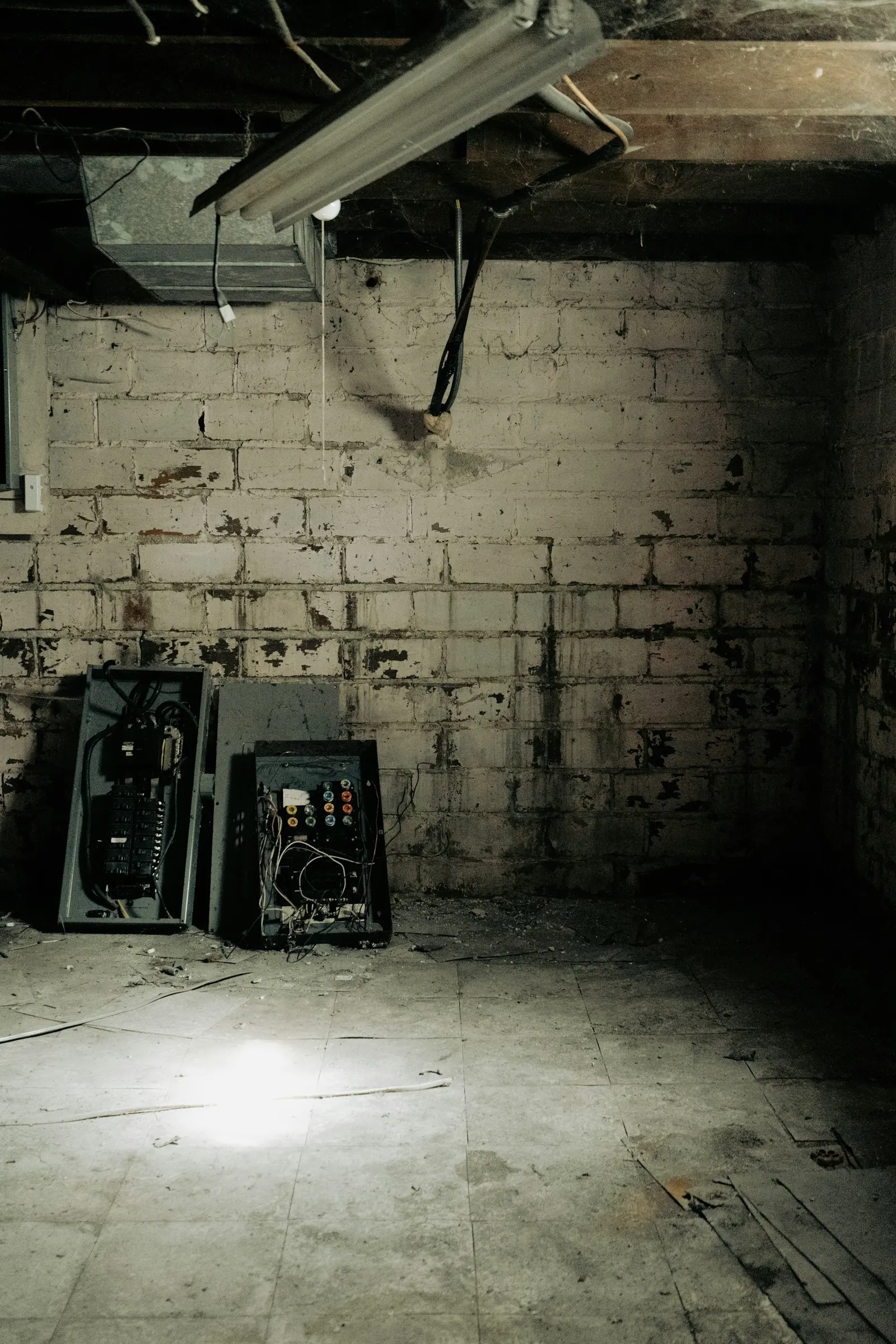
Interior basement waterproofing
A drain inside the basement, under the edge of the floor, that collects water at the footing and takes it to a sump. The yard is untouched and the work goes in through the winter.
- Whereinside, along the wall
- Seasonany
- Time2–4 days per wall run
- Disturbsa 30 cm strip of floor
In section
How the system works
- Wall membraneA dimpled sheet fixed to the wall from the cove joint up. Seepage runs down behind it instead of across the floor.
- Pipe beside the footingThe slab is cut back about 30 cm, the soil removed to the footing, and perforated pipe laid in clear stone.
- Run to the sumpThe pipe falls to a pit, usually in the lowest corner, under a new strip of concrete.
- Discharge outsideThe pump sends it out through the wall to ground that slopes away, or to a dry well on a flat lot.
When it is the right choice
Four situations where inside beats outside
Water from below
On the Lake Simcoe and Bass Lake flats the water table can sit within a metre of the floor. An exterior membrane does nothing for water rising through the slab; an interior drain and pump does.
The yard cannot be dug
A deck across the back, a driveway on the side, a septic bed or well line too close to the wall. The interior system needs none of that moved.
It is January
Excavation waits for thaw. An interior system does not. If the basement is wet now, this is the repair that can start now.
The budget is fixed
Less labour, no machine, no landscaping to reinstate. For the same wall length it is the lower-cost system, and we say by how much in the written scope.

What it does not do
Be honest about the wall
An interior system manages water; it does not keep the wall dry. Concrete on the soil side stays damp, which is fine for a poured wall and acceptable for a sound block wall, but not for a block wall that is already spalling or a basement where the framing must never see moisture. In those two cases we recommend exterior work even when the interior system would be cheaper, and we put the reason in writing.
After the system is in, the basement can be finished in the normal way: framing stands off the wall, the membrane sits behind it, and the drain is under the slab where it stays accessible through the sump lid.
Compare with exterior waterproofingWater on the floor after every rain? Book the assessment and we will tell you whether this is the fix.
Book a free assessmentQuestions
About interior systems
Can I finish the basement afterwards?
After an interior system, yes: the membrane sits behind the framing and the drain is under the slab, so the finished wall is built as normal with an air gap at the bottom. After an exterior job the inside is untouched and you can finish immediately. What we ask is that you wait through one spring first if the basement has a history of standing water, so that the repair has been tested by the wettest weeks of the year.
Interior or exterior: which one do I need?
Exterior waterproofing stops water before it touches the wall, so it is the answer when the wall itself must stay dry: a finished basement you want to keep, block walls that are deteriorating, or a wall that leaks along its whole length. Interior drainage collects water once it reaches the wall and pumps it out, so it suits houses where the yard cannot be dug, where the water comes up through the floor, or where the budget has to stay lower. Many houses get both: a crack injected from inside and grading fixed outside.
Our house has a concrete block foundation. Is that a problem?
Block walls are hollow, so water that gets past the outer face fills the cores and comes out at the bottom course, often along a whole wall rather than at one spot. Injection does not work on block. The repair is either exterior waterproofing of the wall face or an interior system with a membrane that drains the cores at the base. Older houses in the village cores of the township are mostly block; newer subdivisions are poured.